
You can’t fix a workplace you don’t understand.
I help leaders understand what people are experiencing at work, work out what’s driving it, and decide what needs to change.
The workplace you think you have might not be the workplace people experience.
It often shows up as survey results that don’t match what you’re seeing, a change that isn’t landing as intended, or concerns that keep coming back despite action plans.
[01] The gap| Leadership intentYou know why a decision was made. | Employee experienceYour people know what it means for them. |
|---|---|
| “Flexible working is open to everyone.” | Asking to use it feels like a career risk. |
| “Our door is always open.” | We’ve learned which conversations are better avoided. |
| “We restructured so we can move faster.” | Nobody is sure who decides anything now. |
| “We asked for honest feedback.” | Nothing changed last time. Why be honest now? |
Illustrative examples, not findings from any one organisation.
You know what people answered.
What did they feel able to say?
And what did they decide was safer to keep to themselves?
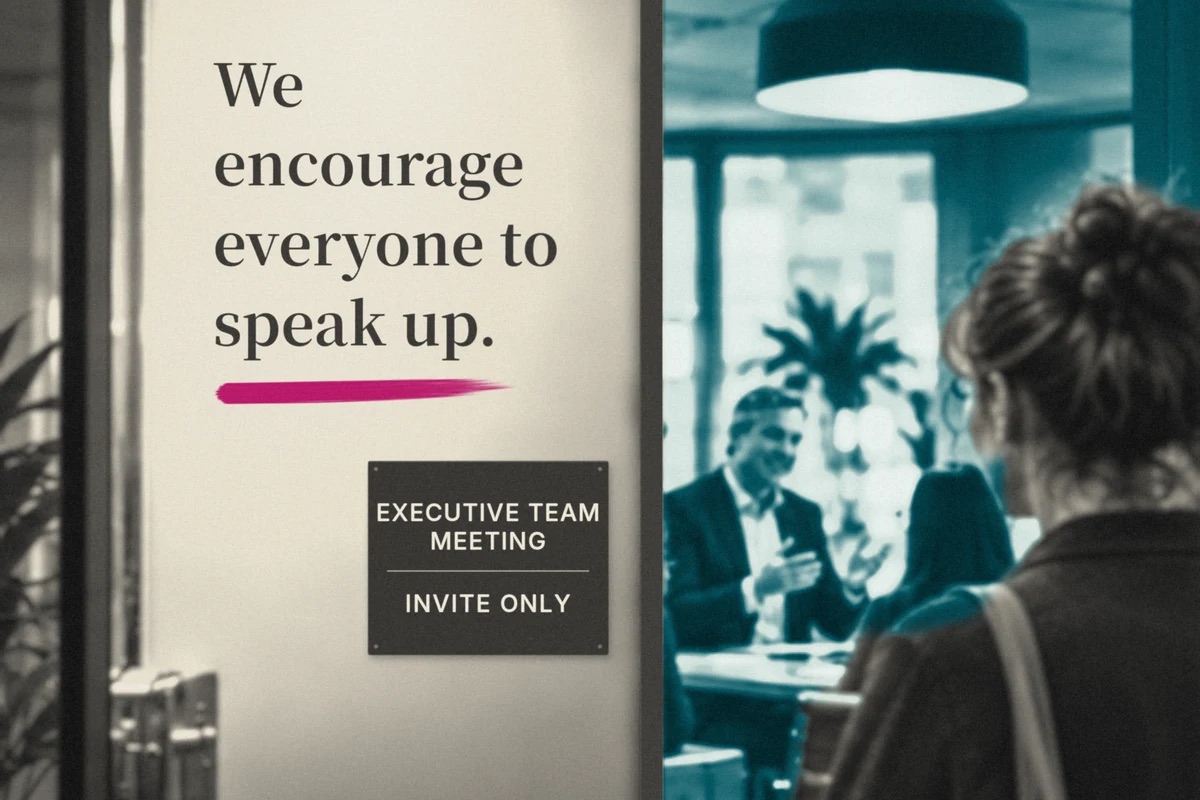
Silence has consequences.
Problems that go unspoken don’t necessarily go away. They can surface as unwanted turnover, wasted effort, delayed decisions or changes that don’t deliver what leadership intended.
Before you can address those costs, you need to understand what’s driving them.
Grounded in research. Built for organisational reality.
Organisations control their actions. They don’t control how those actions are interpreted.
But how actions are designed, communicated and carried out shapes what they come to mean.
How organisational actions become employee experience
- Organisational actionsWhat the organisation does
- Signals · interpretation · judgementWhat people read into it
- InterpretWhat does this say about how we’re seen?
- JudgeIs it fair?
- Psychological safetyWhether it feels safe to speak up
So how do you find out what’s really going on?
- 01
Listen
Understand the problem and existing evidence, then listen across the relevant parts of the organisation to find out where experiences differ.
- 02
Diagnose
Identify the patterns, gaps and interpretations, and what may be driving them.
- 03
Build the response
Work with leadership to identify which decisions, practices and behaviours need attention, agree priorities and establish responsibility.
- 04 · Agreed separately
Listen again
Find out whether it helped, and what still needs attention.
Doing something isn’t the same as changing something.
What you leave with
The work is scoped around your circumstances, not a predetermined programme.
- A clearer picture
What people are experiencing, including what existing evidence may have missed.
- An explanation grounded in evidence
What’s contributing to the problem, what the evidence supports and what remains uncertain.
- A practical way forward
Priorities developed with leadership, clear ownership and an approach to communicating decisions.
Support with implementation, and a later look at whether things changed, can be agreed separately, bringing in trusted specialists when the scale or complexity calls for a wider team.
Sound familiar?
Tell me what you’re seeing in your organisation. We can work out whether FPX is the right place to start.
Give people room to tell you what the survey missed.
A score can flag a problem. It doesn’t explain what happened, or why it matters.
I use Voxant within FPX engagements: AI‑led voice interviews that give people space to describe, in their own words, experiences they may not raise through conventional channels.
“What could happen to me if I say this?”
People need confidence that speaking openly won’t expose them to individual scrutiny. Voxant is designed to protect their participation and keep organisational reporting focused on patterns rather than individuals.
Patterns, not individuals.

Leaders never see
- Who took part, or who declined
- Individual interview transcripts. Consultants work from the synthesis too
- Separate results or quotes for any group smaller than five
Leaders receive
- Synthesised findings across the organisation
- De‑identified quotes, labelled only for groups of five or more
- Evidence that supports human judgement, not replaces it
For participantsTold they’re speaking with AI, and free to pause, skip a question or stop.
Not surveillanceNo ranking of individuals, no emotion inference, no automated employment decisions.
Voxant is currently in private beta; these are the controls its documentation describes for the beta.
Read Voxant’s trust and privacy documentationBeing heard doesn’t mean getting a yes.
What happens after people speak up
- Psychological safety · voiceAble to speak up
- Organisational responsivenessResponded toGenuinely considered and, where the answer is no, explained.
- Response felt genuine
- Response felt performative
- Perceived influenceDid it count?Not the same as agreement.
- Where the response felt genuine: Trust can strengthen
- Where the response felt performative: Trust can erode
What you do after asking shapes what people will tell you next time.
Listening is evidence, not a vote: look for patterns and make decisions you can explain.

I’m Marion.
I’m a People leader, researcher and founder of The Fearless PX.
I’ve spent more than two decades in international People and HR leadership across the UK, Middle East, India and the US, including roles at Apple, IKEA and Walmart. As Global VP of People & Culture at Channel Bakers, I built and led the People function as the agency grew across multiple international markets.
I hold an MSc in International Human Resource Management, am a Chartered Member of the CIPD (MCIPD), and am completing my professional doctorate at Glasgow Caledonian University, exploring how organisational signals shape psychological safety across distributed work.
 Member, Future of Work Alliance (opens in a new tab)
Practitioner.
I’ve built People teams, supported leaders through difficult changes, and had the conversations where policy meets somebody’s actual life. I understand the constraints. I also know why they need questioning.
Researcher.
My doctoral research explores how organisational actions shape what feels safe to say and do. It informs the questions I ask and how I read the evidence.
Lived experience.
I’ve been responsible for organisational decisions and lived with the consequences of decisions made by others. That keeps me attentive to the distance between intention and experience.
Ideas & conversations
Explore the questions behind my work through publications, podcast conversations and The Elephant in the Org archive.
Start with what you’re seeing.
You don’t need a diagnosis before we talk.
Our first conversation is about your situation, what you need to understand, and whether FPX can help. If it can, I’ll follow up with a proposed scope of work.
Emailmarion@thefearlesspx.com